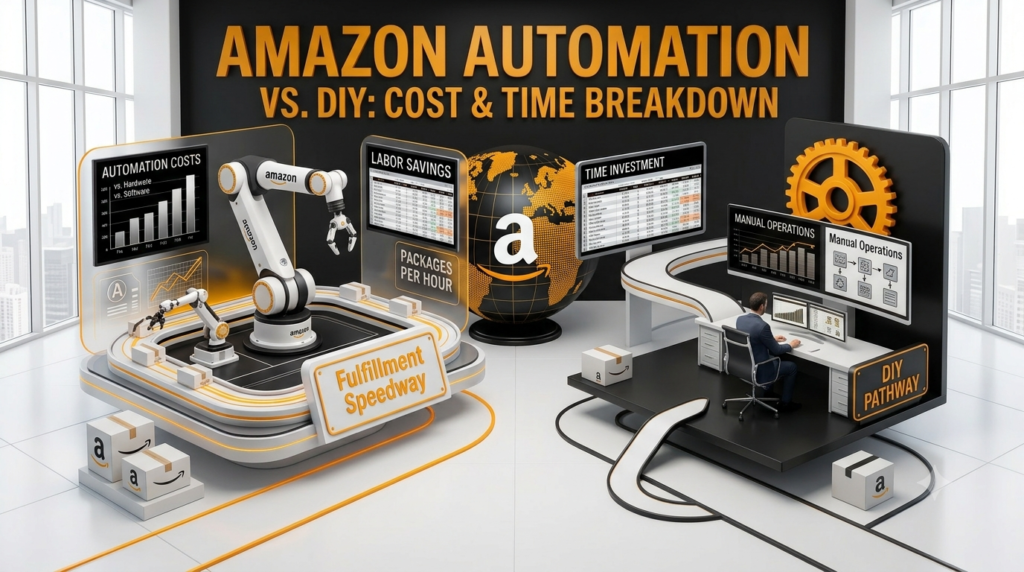
Amazon Automation vs DIY is one of the biggest decisions new eCommerce entrepreneurs face in 2026. Both approaches have unique advantages, costs, and time commitments.
Most people who look into selling on Amazon hit the same wall within the first week. They discover there are two completely different paths forward, and almost nobody explains the real tradeoffs between them.
One path is doing everything yourself. Sourcing products, building listings, running ads, answering customer emails, watching your account health like a hawk. The other path is paying someone else to run the store for you, an Amazon automation service that handles the operational side while you stay in the role of investor.
Neither path is automatically the “smart” choice. It depends on how much time you actually have each week, how much capital you’re willing to put at risk, whether you already understand retail or ecommerce, and how fast you want to scale.
This article breaks down the real cost differences, the real time commitment, and the honest pros and cons of both models. No inflated numbers, no exaggerated promises. Just a practical comparison you can use to decide which path fits your situation.
What Is Amazon Automation?
Amazon automation is a service model where a specialized team handles the day to day operations of an Amazon store on behalf of the store owner. The owner supplies the capital and owns the Amazon seller account, while the automation agency manages product research, supplier sourcing, listing optimization, advertising, and ongoing account management.
In a typical arrangement, the agency identifies profitable product opportunities, negotiates with suppliers, creates and optimizes the product listings, and runs the advertising campaigns needed to generate sales. The owner usually receives regular performance reports and has visibility into the account through Seller Central.
What the owner still manages matters just as much as what the agency handles. The owner is responsible for funding inventory purchases, reviewing the agency’s recommendations, approving major decisions, and monitoring performance. A legitimate automation arrangement is not a “set it and forget it” investment. It’s closer to owning a business with an operations team already in place, where you still need to stay engaged as the decision maker.
There’s a common misconception that automation means zero involvement or guaranteed profit. That isn’t accurate. A good agency reduces the operational workload and brings expertise you might not have, but the store owner still carries the financial risk of the business, and results depend heavily on the quality of the agency and the products chosen.
What Does DIY Amazon Selling Mean?
Doing it yourself means exactly what it sounds like. Every function of the business sits on your shoulders, at least until you decide to hire help.
Here’s what that actually involves on a week to week basis:
- Product research. Finding a product with real demand, manageable competition, and healthy margins takes hours of research using tools like Helium 10 or Jungle Scout, plus manual judgment calls.
- Supplier hunting. Vetting manufacturers, requesting samples, negotiating pricing, and confirming quality before placing a bulk order.
- Inventory management. Forecasting demand, managing reorder timing, and avoiding both stockouts and overstock, which ties up cash.
- Listings. Writing titles, bullet points, and descriptions that convert browsers into buyers while also satisfying Amazon’s search algorithm.
- SEO. Researching keywords and structuring listings so your product actually surfaces in search results.
- PPC advertising. Building and adjusting ad campaigns, monitoring ACOS, and avoiding wasted ad spend.
- Customer support. Responding to buyer messages, handling complaints, and managing expectations.
- Returns. Processing refunds and exchanges while tracking how they affect your margins.
- Account health. Watching for policy violations, negative feedback trends, and performance metrics that could get an account suspended.
None of these tasks are impossible to learn. Plenty of sellers teach themselves successfully. But learning all of them at once, while also running the business, is where most new sellers get overwhelmed.
Amazon Automation vs DIY: Cost Breakdown
Cost is usually the first question people ask, and it’s also where the two models diverge the most. Here’s a realistic side by side comparison.
| Expense | DIY | Automation |
|---|---|---|
| Business Registration | Handled by you, low cost | Usually handled by you or guided by the agency |
| Inventory | Full cost paid directly by you | Full cost still paid by you, agency helps select products |
| Software | You pay for research and PPC tools yourself | Usually included in the agency’s service |
| Advertising | You manage budget and often overspend while learning | Managed by an experienced team, reducing wasted spend |
| Management | Your own time, unpaid | Monthly management fee to the agency |
| Time Investment | High, especially in the first year | Low to moderate, mainly for oversight |
| Learning Cost | Courses, trial and error, mistakes that cost money | Minimal, since the agency brings existing expertise |
The inventory cost is identical in both models because that money goes toward the physical product either way. The real difference is in who pays for expertise. With DIY, you pay in time and mistakes. With automation, you pay a service fee in exchange for that time and those mistakes being reduced.
Pro Tip: Before signing with any automation company, ask exactly what their management fee covers and get it in writing. Vague fee structures are one of the most common red flags in this industry.
Time Comparison
Time is the other half of this decision, and it’s often underestimated by people comparing the two paths.
| Task Area | DIY (Hours per Week) | Automation (Hours per Week) |
|---|---|---|
| Product Research | 5 to 10 | 0 to 1 (reviewing recommendations) |
| Supplier Communication | 3 to 6 | 0 to 1 |
| Listing Creation and SEO | 4 to 8 | 0 |
| PPC Management | 3 to 5 | 0 to 1 |
| Customer Support | 3 to 7 | 0 to 1 |
| Account Monitoring | 2 to 4 | 1 to 2 |
| Estimated Weekly Total | 20 to 40 hours | 2 to 6 hours |
These figures reflect the first six to twelve months. DIY sellers who survive the learning curve often reduce their weekly hours over time as systems get built and tasks get delegated. Automation clients typically stay in that lower range throughout, since the operational workload sits with the agency rather than shifting over time.
Pros and Cons of DIY
Pros:
- Full control over every decision in the business
- No monthly management fees eating into profit
- You build real, transferable ecommerce skills
- Complete transparency since you’re doing the work yourself
Cons:
- Steep learning curve with real financial consequences for mistakes
- Significant time commitment, often on top of a full time job
- Slower path to scaling since you’re the bottleneck
- Higher risk of account issues from inexperience
Pros and Cons of Amazon Automation
Pros:
- Frees up your time since the operational work is handled for you
- Access to experience and systems that took the agency years to build
- Often faster to launch since the team already has established processes
- Easier to scale to multiple products or stores without your personal time being the limiting factor
Cons:
- Monthly management fees reduce overall profit margin
- You depend on the agency’s quality and honesty
- Less hands on control, which doesn’t suit everyone
- The industry has a reputation problem due to bad actors, so vetting is essential
Which Option Is Better for Beginners?
Honestly, it depends on what kind of beginner you are, not just that you’re new.
If you’re new to Amazon but have significant free time, a genuine curiosity about ecommerce, and you’re comfortable with a slower, more painful learning curve, DIY can work well. Many successful sellers started exactly this way.
If you’re new to Amazon but you have a demanding job, limited free time, and you’d rather invest capital than hours, automation can make more sense, provided you choose a reputable company and go in with realistic expectations about returns.
What doesn’t work well for beginners in either category is assuming either path guarantees fast, easy profit. Both require patience and a willingness to treat this as a real business, not a shortcut.
Who Should Choose DIY?
DIY tends to suit people who:
- Have more time than capital available right now
- Enjoy learning marketing, operations, and negotiation firsthand
- Want to eventually build multiple income streams using the skills gained
- Are comfortable with a longer timeline before seeing consistent profit
- Prefer full control over every part of the business
Who Should Choose Amazon Automation?
Automation tends to suit people who:
- Have investable capital but limited weekly time
- Value expertise over control
- Want to scale faster without personally managing every task
- Are comfortable doing thorough due diligence on the agency they hire
- View this as a business investment rather than a side hustle they’ll manage themselves
Common Mistakes People Make
Hiring fake agencies. The Amazon automation space has attracted its share of bad actors making unrealistic promises. Always verify a company’s track record, ask for references, and be wary of guaranteed profit claims.
Choosing based on price alone. The cheapest management fee isn’t always the best deal. A slightly higher fee from an experienced, transparent team often outperforms a bargain agency with no real track record.
Ignoring inventory costs. Both DIY and automation require real capital for inventory. Some new sellers underestimate this and run out of cash before the business gains traction.
Expecting passive income immediately. Neither model produces overnight profit. Products need time to rank, build reviews, and gain sales momentum.
Not researching suppliers. Whether you’re doing this yourself or trusting an agency, supplier quality directly affects returns, reviews, and account health. This step should never be rushed.
Expert Insight: The biggest factor separating a successful automation partnership from a failed one usually isn’t the product category. It’s how much transparency and reporting the store owner receives. If you can’t see clear performance data whenever you ask for it, that’s worth addressing early.
How to Choose the Right Amazon Automation Company
If you’re leaning toward automation, a bit of due diligence up front saves a lot of frustration later.
- Ask for verifiable client results, not just testimonials on their website.
- Get full clarity on the fee structure before signing anything.
- Confirm who owns the Amazon seller account. It should always be you.
- Ask how often you’ll receive performance reports and what they include.
- Find out what happens if the account underperforms. A credible agency will have a clear answer.
- Check how long the company has actually been operating in this space.
- Read the contract carefully, especially around cancellation terms.
A reputable Amazon automation company will welcome these questions. Hesitation or vague answers are worth treating as a warning sign.
Key Takeaways
- DIY offers full control and no management fees, but requires significant time and a real learning curve.
- Automation reduces your time commitment and brings in existing expertise, but comes with monthly fees and requires trusting the agency you choose.
- Inventory costs are similar in both models since that capital goes toward the product either way.
- Beginners should choose based on available time and risk tolerance, not just which option sounds easier.
- Vetting an automation company thoroughly is just as important as choosing the right product.
- Neither path guarantees fast or passive profit. Both require patience and active involvement from the owner.
Final Thoughts
There’s no universally better choice between Amazon automation and DIY selling. What matters is matching the model to your actual time, capital, and risk tolerance, not to whichever option sounds more appealing on social media.
If you have the hours and the appetite to learn, DIY can be a rewarding, skill building path. If your time is limited and you’d rather invest capital into an experienced team, automation can be a practical way to participate in ecommerce without taking on every operational task yourself.
Whichever direction feels right for you, take the time to research thoroughly before committing. If you’d like an honest conversation about whether automation fits your goals, the team at Automation Amazom offers a free consultation to walk through your options with no pressure attached.